Your acne cleared years ago and the scars stayed. Laser Coring lifts micro columns of that scar tissue out rather than heating them, and Dr Mattia walks you through every day of the healing.
The acne itself cleared years ago. What stayed was the surface it left behind, the small pits across your cheeks and the uneven texture that side lighting finds before you do. Make-up does not sit on them so much as settle into them. That is the skin Laser Coring at Cannelle Skin Clinic in Oxford was built for.
Laser Coring is the deepest of the three UltraClear treatments, and it is the genuinely new idea in resurfacing. Instead of heating scar tissue and hoping it softens, it removes micro columns of that tissue outright. Each column is lifted away under topical numbing, and your skin closes the gap with new tissue of its own. Dr Mattia Parducci holds the handpiece for every session.
The thinking behind it was presented at the American Academy of Dermatology annual meeting in March 2026. UltraClear works at 2910 nm through a cold fibre, so about 95% of its energy removes tissue and about 5% lingers as warmth. That warmth stays inside each channel rather than spreading into the skin around it. Scar tissue comes out, and the skin beside it heals quickly.
Every resurfacing laser before this one worked mainly by heating, which stiffens and shrinks scar tissue so the body remodels what is left over the months that follow. It is a real effect, and a great many scars have been improved that way. The limit is that heated tissue is still tissue, which is why deep, established scars so often improved and then stalled.
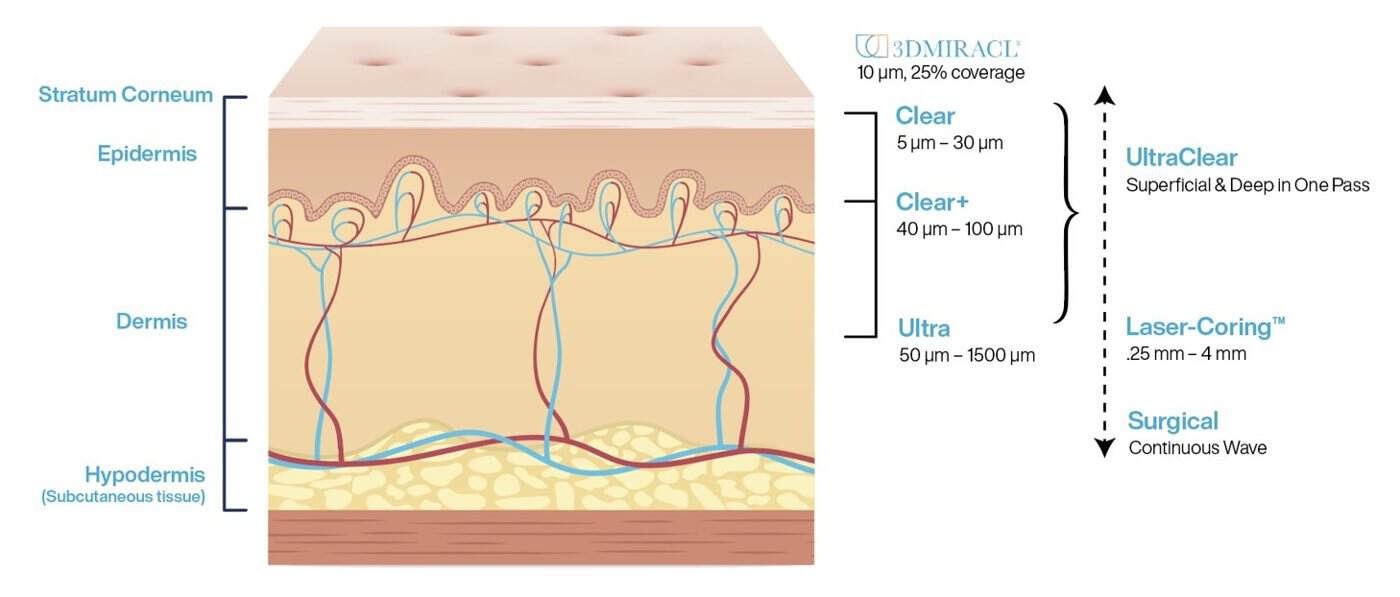
Coring changes the question from how much heat to how much tissue. A narrow column of scar is ablated from the surface down into the dermis and taken away. A 2024 histology series measured those channels at around 980 micrometres, a shade under a millimetre, and recorded no dark marks or scarring across the patients studied. What fills the space afterwards is your own new tissue.
The elegance is in how little is taken at a time. The columns are microscopic and widely spaced, so most of your cheek is untouched and heals the treated points quickly. Coring reaches what heat alone never quite shifted, a fraction of a millimetre at a time. Dr Mattia plans the pattern, the depth and the spacing from the scars in front of him.
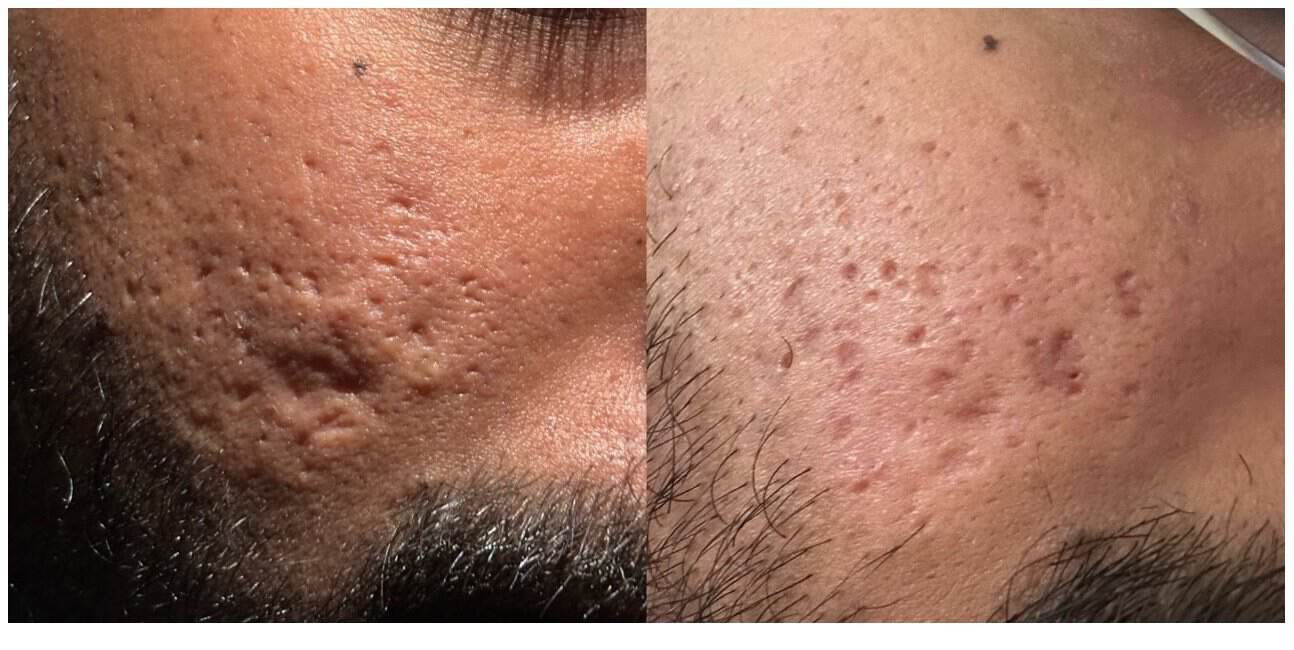
Acne leaves more than one kind of mark, and they behave differently under a laser. The narrow, deep pits are hardest to reach with anything that works from the surface. Wider, softer dips and broad uneven texture across the cheeks respond well to depth and patience. Dr Mattia looks at all of it, because most faces carry a mixture rather than one type.
Established scarring and long-standing texture are what Laser Coring is for. Shallower marks often do better with a gentler approach, and microneedling suits that softer end of the range. Our page on acne scarring sets out what he assesses before he chooses. The flat brown or red marks left behind by a breakout are pigment rather than scarring, and they answer to something else entirely.
Oxford has a particular stake in this. The median age here is 31, the second youngest in England and Wales, and around 36,000 full-time students live in the city. Almost a third of residents are aged 18 to 29, and their scars have long outlasted the spots. If the acne itself is still active, start with our guide to acne treatment options.
Topical numbing goes on first and is given time to work. Dr Mattia then passes the laser across the scarred areas, coring as he goes. Because tissue is removed rather than warmed, there is pinpoint bleeding on the day, and across scars it can be considerable. That is the honest price of taking scar out rather than heating it, and it is why coring reaches so far.
The 2024 acne scar study described exactly this picture, with trace to mild redness, swelling and pinpoint bleeding. None of it is a surprise on the day, because Dr Mattia walks you through the sequence before he starts. The bleeding settles as the skin seals over the hours that follow. You go home with a written routine rather than a vague instruction to be careful.
Healing runs to seven to fourteen days and has a predictable shape. The first days are pink, warm and tight, much like a strong day spent in the sun. The surface then flakes as new skin comes through, finer and more even than the one it replaces. Barrier cream and gentle cleansing carry you through, with no heat, exercise or swimming until you have healed.
Sunscreen goes on every morning from the moment your skin can take it. Dr Mattia gives you the date on which your retinoids and acids come back, so nothing is left to guesswork. The fortnight is part of the plan, and you will know the dates before anything is booked. The concern decides the treatment, and the treatment brings its own recovery with it.
Laser Coring is often one to three sessions, spaced four to six months apart, because collagen keeps reorganising for months after each one. Texture, tone and firmness go on improving for three to six months once healing has finished. Dr Mattia asks you to judge the result at three months rather than at three weeks.
Once the new surface has fully come through, the difference stops being subtle. Pits read shallower, the edges of each scar soften, and light travels across the cheek instead of stopping at every dip. That change keeps building quietly while you get on with your life, and it is a course with an end rather than a treatment you return to forever.
UltraClear works on the surface and on the collagen beneath it, and that is the whole of its job. It does not restore lost volume, and Dr Mattia says so plainly where volume is part of the picture. He treats the whole face rather than a single layer of it. If another treatment would serve your scars better, you will hear that at the consultation.
Nothing is planned until Dr Mattia Parducci (GMC 7635663), our Lead Aesthetic Doctor, has seen the scars himself. He works under clinic lighting and then VISIA imaging, which shows the depth and spread of scarring beneath what a mirror shows. From there you talk through which scars bother you most and how your skin has behaved before. He performs every UltraClear session at Cannelle himself.
Dr Mattia sets the depth and the spacing for your scars himself, never to a default setting. Behind that judgement sit more than 100 of these laser treatments at our sister clinic in London, Dr Joney De Souza Skin & Laser. You can read more about him on his profile page.
A few questions come with the examination, and they matter more for coring than for anything lighter. Any isotretinoin in the past year, how your skin has scarred before and whether it has ever thickened, a history of cold sores, a tan, and whether you are pregnant or breastfeeding. Your answers set both the depth and the date.
UltraClear was designed for every skin tone, from Fitzpatrick I to VI, and it holds a 2026 NewBeauty Beauty Award as Best Laser Treatment for All Skin Tones. Deeper tones are patch tested on a small, discreet area at least 24 hours before the first full session, so your settings are decided on your own skin.
One to three sessions is the average, and the consultation gives the real answer for your skin. You leave knowing what is being treated, how the fortnight of healing goes and when your face will look like itself again. Acne scarring has been treated as permanent for decades, and it is worth finding out what a laser that lifts scar tissue out can do with yours.
Patients travel to our Summertown clinic, welcoming patients from across Oxfordshire from Cowley, Headington and Marston, and a scar that old is worth the journey. The only UltraClear in Oxford performed by an experienced doctor is here. If your scars have sat with you since sixth form, come and let Dr Mattia look at them properly. Have a look at the UltraClear before and afters, then get in touch and we will get you in to see him.
The doctor who performs every UltraClear session at Cannelle, filmed treating with the same laser at our sister clinic in London, Dr Joney De Souza Skin & Laser. Watch how the handpiece moves, how calm the skin stays, and how little fuss the whole thing involves.
If your scars have outlasted the acne by years, come and let Dr Mattia Parducci look at them under VISIA imaging. He will tell you honestly what Laser Coring can reach and how the healing runs. Ring the clinic on 01865 511960, or send us a message on WhatsApp.
These are the questions people ask most when they first hear that scar tissue can be removed rather than heated. Dr Mattia answers the rest properly at your consultation.
Laser Coring is the deepest of the three UltraClear treatments. Under topical numbing it removes micro columns of scar tissue outright rather than heating them, and your skin then fills the space with new tissue of its own. A 2024 histology series measured those channels at around 980 micrometres deep. Dr Mattia performs every session himself and plans the pattern from the scars in front of him.
Yes, and it is worth knowing before the day. Coring lifts columns of tissue out instead of warming them, so there is pinpoint bleeding during the session, and across a scarred cheek it can be noticeable. It settles as the skin seals over the hours that follow. A 2024 acne scar study described trace to mild redness, swelling and pinpoint bleeding, which is exactly the picture Dr Mattia describes to you beforehand.
Seven to fourteen days, with a predictable shape to it. The first days are pink, warm and tight, much like a strong day in the sun, and the surface then flakes as new skin comes through. Barrier cream, gentle cleansing and daily sunscreen carry you through, and there is no heat, exercise or swimming until you have healed. Dr Mattia writes the routine down and gives you the dates.
Often one to three, spaced four to six months apart. That spacing is deliberate, because collagen keeps reorganising for months after each session and most of the change happens in between visits. The depth and spread of your scarring both move the number. That is the average, and the consultation with Dr Mattia gives the real answer for your skin.
Topical numbing goes on first and is given proper time to work, so what you feel during the pass is warmth and pressure rather than sharp pain. Dr Mattia performs the treatment himself and adjusts as he goes, so you are never asked to tolerate more than you need to. Afterwards the skin feels tight and warm for a day or two, much like sunburn.
Established scarring and long-standing texture, including the narrow, deep pits that surface treatments never reach. Wider, softer dips and broad uneven texture across the cheeks respond well too. Shallower marks often do better with microneedling, and Dr Mattia will say so rather than reach for the deepest tool. Most faces carry a mixture, which is why he assesses all of it at once.
UltraClear was designed for every skin tone, from Fitzpatrick I to VI, because so little heat spreads into the skin around each channel. It holds a 2026 NewBeauty Beauty Award as Best Laser Treatment for All Skin Tones, and the 2024 histology series recorded no dark marks across the patients studied. Dr Mattia patch tests deeper tones at least 24 hours before your first full session.
The difference arrives with the new surface, at the end of the healing fortnight. Pits read shallower and the edges of each scar soften, so light travels across the cheek instead of stopping at every dip. Texture and firmness keep improving for three to six months as collagen reorganises, and Dr Mattia asks you to judge the result at three months.
It depends on the depth of the scarring, and that is a judgement Dr Mattia makes at your consultation with VISIA skin imaging. Microneedling suits softer, shallower scarring and carries a much lighter recovery. Laser Coring is for established pitted scarring that surface treatments have not shifted. If the gentler option would serve you better, he will tell you honestly and explain why.
The coring is done by Dr Mattia Parducci (GMC 7635663), our Lead Aesthetic Doctor, from the first pass to the last. That experience runs to more than 100 of these laser treatments at our sister clinic in London, Dr Joney De Souza Skin and Laser. He sets your settings, your spacing and your aftercare personally, and the UltraClear treatment page carries the full detail.
Our clinic is located in Summertown, Oxford, just north of the city centre in one of Oxford’s most sought-after neighbourhoods. Discreet and easy to reach, we offer a premium setting for bespoke skin, aesthetic and wellness care.
We welcome patients from across Oxford city and Oxfordshire, including Summertown, Headington, Kidlington, Abingdon, Bicester, Witney and the surrounding towns and villages. Whether you’re coming for routine skin-health treatments or specialist aesthetic consultations, our location is well connected and simple to access.
Our clinic, Cannelle Skin Clinic, is just minutes from Oxford city centre and easily reached by car, bus or rail. Oxford’s mainline stations Oxford Station and Oxford Parkway are a short taxi or bus ride away, and regular services link to London, Reading, Didcot, Banbury and beyond.
By car, we’re conveniently accessed via key local routes with nearby parking options; by public transport, frequent bus routes along Banbury Road drop you within a short stroll of the clinic.
Whether you’re travelling from within Oxfordshire, further afield in the UK or internationally, our clinic offers a calm, personalised and professional environment for your visit.