


Regenerative injectables
Dr Mattia Parducci
Lead Aesthetic Doctor
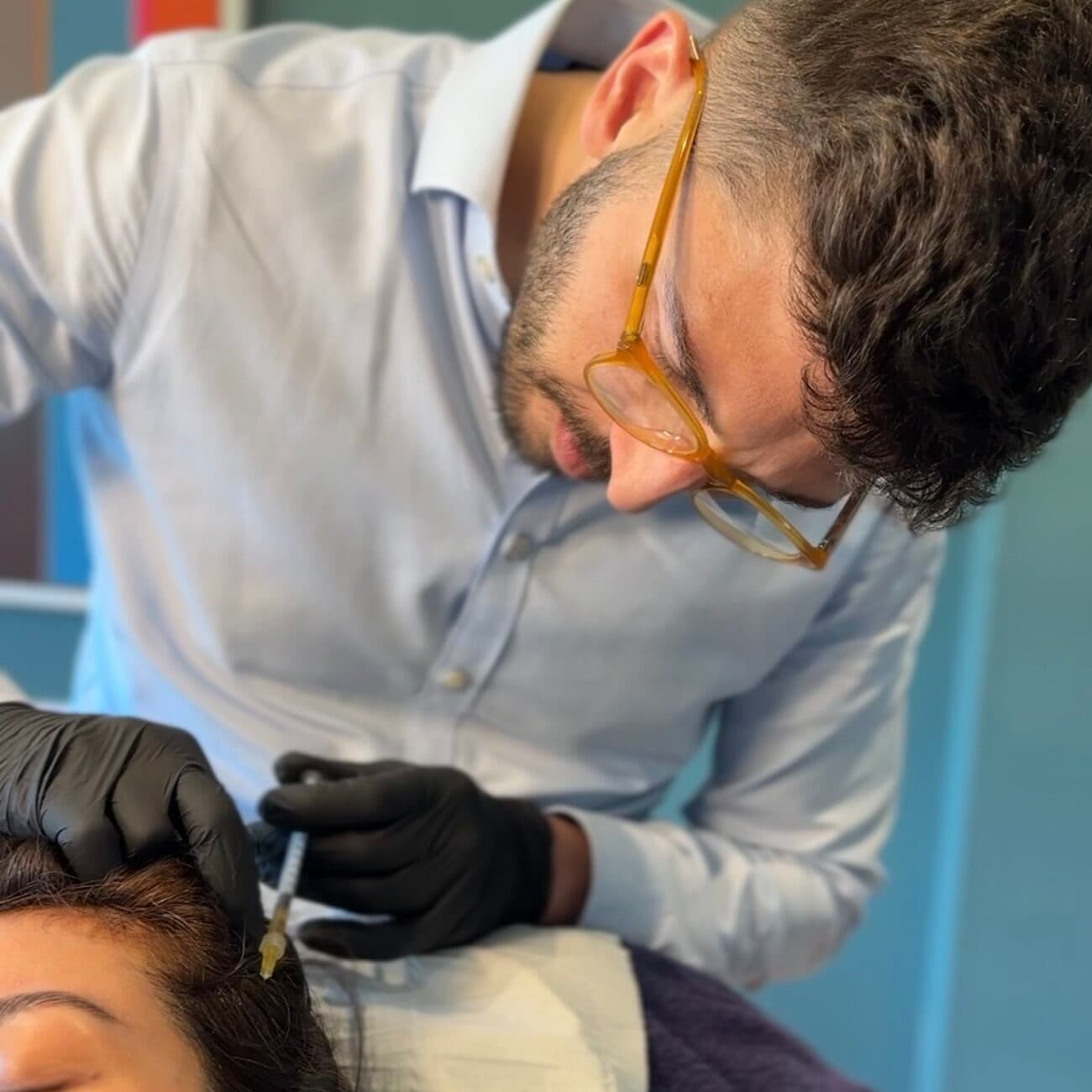
Dr Mattia performs polynucleotide scalp treatment at our Summertown clinic, often alongside PRP across a planned course.
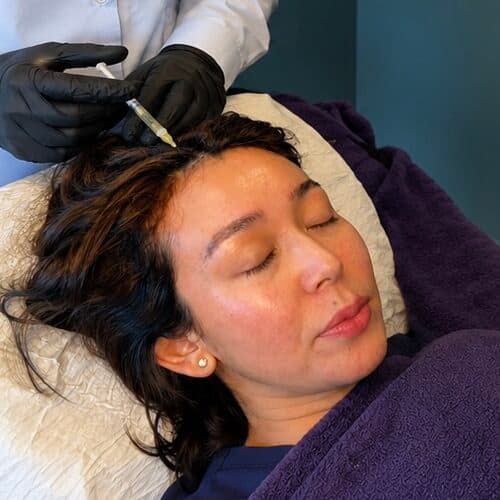
Doctor-led polynucleotide injections for hair loss in Oxford. Dr Mattia at Cannelle Skin Clinic uses PDRN to regenerate the follicular environment and reduce hair thinning.
Doctor-led PDRN injections from Dr Mattia Parducci that repair the follicle environment and drive natural regrowth at Cannelle Skin Clinic in Oxford

Thinning hair rarely announces itself. You notice a wider parting, more strands in the brush, a scalp showing through under bright light. At Cannelle Skin Clinic in Oxford, polynucleotide (PDRN) hair injections give weakening follicles a genuine chance to recover. The treatment suits men and women and works at the follicular level, so it targets the root of thinning rather than the surface. Dr Mattia Parducci leads every session.
Polynucleotides also pair naturally with PRP hair treatment for a fuller restoration programme. Dr Mattia assesses each patient and confirms whether polynucleotides suit you alone, or whether a PRP combination gives the stronger result.
Polynucleotides (PDRN) are injectable treatments made from highly purified salmon DNA fragments. Dr Mattia injects them into the scalp, where they bind to adenosine A2A receptors in the follicular tissue. That binding stimulates cellular regeneration, improves microcirculation and calms the inflammation that drives follicle miniaturisation.
The result is a healthier follicle environment. Across a course, it supports stronger, denser growth. Because polynucleotides are regenerative, they work at a deeper level than scalp-only treatments.
PRP uses your own blood-derived growth factors. PDRN gives the follicles a consistent, standardised regenerative signal every session, so the two complement one another. Many patients combine both.
Polynucleotides for hair form part of our hair loss and body treatments in Oxford at Cannelle Skin Clinic. They pair well with PRP hair treatment. For skin rather than scalp, see polynucleotides for the face.
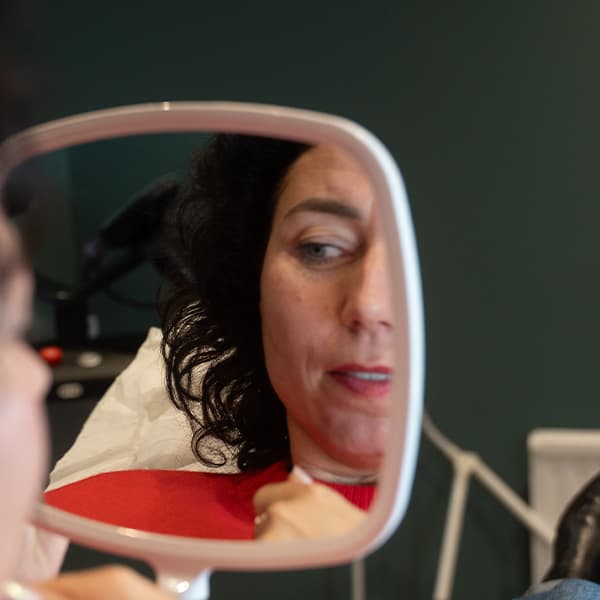
Polynucleotides work differently from most hair treatments. Rather than delivering external growth signals, they switch on your own cellular repair. The PDRN molecule binds to purinergic receptors in the follicular dermis and triggers a cascade of regenerative activity in the scalp.
That activity improves blood supply to the follicle, reduces oxidative stress and supports the dermal papilla cells that drive growth. Most patients complete 2 to 3 sessions. Across the course, compromised follicles recover and resume normal growth cycles.
Dr Mattia begins with a detailed consultation. He checks the pattern, degree and likely cause of your hair loss, then reviews your medical history, expectations and any medications, including blood thinners or anticoagulants. From there he confirms the best approach: polynucleotides alone, or combined with PRP for a stronger result.
Dr Mattia cleanses the scalp, clearing product buildup, oils and debris across the treatment area. A clean surface lets him place the injections accurately and reduces the risk of follicular contamination. Most patients find this step comfortable.
Dr Mattia applies a topical anaesthetic cream and leaves it on for roughly 20 to 30 minutes before injecting. This keeps discomfort low, and most patients feel only mild pressure at each site.
Dr Mattia injects the polynucleotide solution with a fine needle, placing micro-injections across the scalp. He concentrates on areas of greatest thinning and tailors the depth and distribution to your scalp anatomy and hair loss pattern. Most patients notice only minimal discomfort, especially once the anaesthetic has taken effect.
The injection phase takes roughly 20 to 30 minutes. Dr Mattia then reviews the treated areas, confirms placement and gives a brief scalp assessment. Mild redness and small injection-site bumps are normal and usually resolve within several hours. You leave with clear aftercare instructions.
Dr Mattia confirms your plan based on how you respond to the first session, setting the interval and total sessions. Most patients complete 2 to 3 sessions, spaced 4 to 6 weeks apart. After the course, maintenance every 6 to 12 months sustains results. Patients combining polynucleotides with PRP often follow a blended schedule that alternates the two.
At Cannelle Skin Clinic in Oxford, your treatment follows a clear, well-supported path from first consultation through your full course of sessions.
Dr Mattia guides every step in person. As your hair responds and scalp health improves, he adjusts the plan across sessions, so treatment stays matched to your progress.
For 48 hours before each session, avoid blood-thinning medications such as aspirin or ibuprofen. Do not stop any prescribed medicine that cannot be paused; confirm this with Dr Mattia at your consultation.
On the day, arrive with clean hair and a clear scalp, so leave out styling products and dry shampoo. Avoid applying minoxidil on the day of treatment.
If you take any hair loss medications, mention them at your consultation. Some affect the best timing for your sessions.
Your session at Cannelle takes about 60 minutes, including preparation and an aftercare discussion. Dr Mattia first prepares the scalp and applies topical anaesthetic to keep discomfort low.
He then places the PDRN injections across the treatment area using a carefully mapped technique. Most patients tolerate the session well. Some feel mild sensitivity at the injection sites, which settles quickly.
Afterwards, mild redness, small bumps and scalp tenderness at the injection sites are normal and usually settle within 24 to 48 hours. Avoid washing your hair for 12 hours, and skip intense exercise for 24 hours.
Hold off on minoxidil or other topical products for 24 hours too, so the PDRN absorbs undisturbed. Shedding may briefly increase in the first 2 to 4 weeks as follicles enter a regenerative cycle before the growth phase begins.
Most patients then see less shedding and early gains in thickness, typically from 8 to 12 weeks after the first session.
Polynucleotides for hair loss demand an accurate scalp assessment, a precise injection technique and a clinician who understands both PDRN pharmacology and the clinical signs of hair loss.
At Cannelle Skin Clinic in Oxford, Dr Mattia Parducci brings medical training and hands-on experience with regenerative injectables to every consultation. Each patient receives a genuinely personalised plan, never a fixed course applied regardless of response.
Over 330 patients rate Cannelle 4.8 stars on Google. For hair loss, the consultation counts as much as the treatment. Dr Mattia confirms the likely cause, advises whether polynucleotides suit you alone or work better with PRP, and monitors your response across the course.
All treatment takes place in a doctor-led clinical setting in Oxford, easy to reach from across the city and nearby areas, including Headington, Summertown, Kidlington, Witney, Abingdon and Bicester.
Polynucleotides are injectable treatments, so they call for clinical precision and proper patient assessment. Dr Mattia delivers every injection himself, using a mapped technique tailored to your pattern of thinning and scalp anatomy.
This clinical oversight sets a medical standard of care apart from a one-size-fits-all product course, and it is what makes the difference to outcomes across a full programme.


At Cannelle Skin Clinic in Oxford, you can book polynucleotides for hair as a single session or a recommended course of 3 sessions. The course suits patients wanting a meaningful improvement in density and scalp health. Every booking includes a personalised consultation with Dr Mattia.
A single session is a good starting point if you want to test your response first. Active thinning or diffuse hair loss usually calls for more: a course of 3 sessions works best, spaced 4 to 6 weeks apart. Each session builds on the regeneration from the last, so results grow stronger over time.
Some patients combine polynucleotides with PRP hair treatment. Dr Mattia then recommends a blended schedule at consultation, tailored to get the most from both.
Final pricing may vary depending on your treatment plan and clinical assessment.
| Treatment | Price (£) |
|---|---|
Polynucleotides for hair | 350 |
Polynucleotides and PRP both stimulate follicle regeneration, but through different mechanisms. Polynucleotides provide a standardised PDRN signal that reduces follicular inflammation, improves microcirculation and activates the adenosine receptor pathway for tissue repair.
PRP works another way. It delivers concentrated autologous growth factors from your own blood, including PDGF, TGF-beta and VEGF, which directly stimulate dermal papilla cell activity and follicle cycling. The two address overlapping but distinct parts of the follicle environment.
For that reason, many patients at Cannelle combine polynucleotides and PRP in an alternating programme, reaching a fuller regenerative effect than either alone. Dr Mattia advises on sequencing and timing, based on your degree of hair loss and your response during the course.
This pairing can also help when PRP alone falls short. Patients who tried PRP without the results they hoped for often add polynucleotides and see a measurable extra improvement.
Polynucleotides for hair raise plenty of questions, and that is fair. At Cannelle Skin Clinic in Oxford, patients often want to know how the treatment differs from PRP, what a full course can realistically achieve and whether it suits their pattern of hair loss.
The answers below cover the questions Dr Mattia and the team hear most. If you are considering PDRN hair injections in Oxford, start here.
Polynucleotides for hair are injectable treatments that use highly purified PDRN (polydeoxyribonucleotide) molecules to stimulate cellular regeneration in the scalp. Dr Mattia injects the PDRN solution directly into the follicular zone.
There, the molecules activate tissue repair, improve blood supply to the follicles and reduce the inflammation linked to miniaturisation and thinning. Across a course of 2 to 3 sessions, this creates a healthier follicle environment that supports stronger, denser growth.
Yes. Polynucleotides have a well-established safety and efficacy record in regenerative medicine, and their use for hair loss is supported by clinical evidence showing improvements in density, follicle activity and scalp health.
They are increasingly used as a standalone treatment for diffuse thinning and early androgenic hair loss, and work well as a complement to PRP hair treatment in more significant cases. The PDRN formulation is consistent in quality, which makes results reliable compared to approaches that vary widely between patients.
Most patients benefit from 2 to 3 sessions spaced 4 to 6 weeks apart, with maintenance every 6 to 12 months. The exact number varies from person to person.
It depends on the degree of thinning, how well your scalp responds to the first treatment and whether you combine polynucleotides with PRP. Dr Mattia confirms the course at consultation, based on your clinical assessment.
Early changes appear quickly. Within the first 4 to 6 weeks after the first session, scalp health improves and excessive shedding usually reduces. Visible improvement in density and thickness then takes 8 to 12 weeks, because the regeneration cycle needs time before new hair enters the visible growth phase.
The full benefit of a course of 2 to 3 sessions usually shows at 3 to 4 months. Patients who combine polynucleotides with PRP often report earlier visible improvement than with either treatment alone.
Results from a course typically last 6 to 12 months, though the exact duration varies. It depends on the underlying cause of your hair loss, your response and your home hair care.
Maintenance sessions every 6 to 12 months help sustain the improvements from the initial course. Some patients hold results longer, usually those who also address the drivers behind their hair loss, such as a nutritional deficiency or hormonal imbalance.
Polynucleotides have an excellent safety record. The PDRN molecule is biocompatible and well tolerated by scalp tissue. Mild redness, swelling and injection-site tenderness are expected and typically settle within 24 to 48 hours.
More significant side effects are rare when a qualified clinician uses the right technique. Dr Mattia delivers all injections personally within a doctor-led clinical environment, so you receive a high standard of safety throughout your course.
Most patients find the treatment well tolerated. A topical anaesthetic cream reduces discomfort significantly before injections begin. You may notice mild pressure and a brief stinging sensation at each site, but most describe the treatment as manageable and far more comfortable than expected.
Sensitivity also eases after the first session, as you get used to it. The fine needles used for scalp injections make the experience gentler than many patients anticipate.
PDRN (polydeoxyribonucleotide) is the specific active molecule in polynucleotide injections, and the terms are often used interchangeably in aesthetic medicine. Different brands and formulations use PDRN or related compounds at varying concentrations and molecular weights.
At Cannelle, Dr Mattia uses a clinically validated formulation, chosen for its purity, consistency and evidence base in hair and scalp applications. The key distinction is the quality and concentration of the PDRN, which shapes the regenerative response at the follicle level.
Yes, and combining the two often produces a stronger result than either alone. Polynucleotides work mainly through the adenosine receptor pathway, reducing follicular inflammation and stimulating tissue repair. PRP hair treatment delivers concentrated autologous growth factors that directly activate follicle cycling and dermal papilla cell activity.
The two mechanisms complement each other rather than overlap. Dr Mattia advises on sequencing and timing at your consultation, tailored to your degree of hair loss and how your scalp responds during the initial sessions.
Polynucleotide hair injections are not right for everyone. They are not advised for patients with active scalp infections, keloid scarring or certain blood-clotting disorders, and they are unsuitable for autoimmune conditions such as alopecia areata.
Patients on anticoagulant therapy may need a modified approach or a period without medication first. Pregnancy and breastfeeding are contraindications. Dr Mattia reviews your medical history and current medications at consultation, to confirm suitability before proceeding.
Aftercare is simple, and it matters. After treatment at Cannelle, avoid washing your hair for 12 hours and intense exercise for 24 hours. For 24 hours, do not apply minoxidil, topical hair treatments or styling products. Avoid saunas, steam rooms or direct heat to the scalp for 48 hours.
Mild redness and injection-site bumps usually settle within 24 to 48 hours. Dr Mattia confirms specific aftercare at the end of each session, including any adjustments for patients using concurrent treatments such as minoxidil or supplements.
Once patients understand what a polynucleotide hair treatment involves, new questions follow. Most ask how it compares to PRP, minoxidil or a hair transplant. Others want to know what it costs and whether it is worth it long term.
The answers below cover the most common comparisons, along with the practical questions the Cannelle team hears about PDRN hair injections in Oxford.
Neither is universally better. Polynucleotides provide a consistent PDRN-based regenerative signal, so they excel at reducing follicular inflammation and improving scalp microcirculation.
PRP hair treatment delivers concentrated growth factors from your own blood, directly stimulating follicle cycling, so it suits active hair loss well. The two complement each other.
Many patients at Cannelle get their best results by combining both in a blended programme rather than choosing one over the other.
For a detailed side by side, read our guide: PRP vs polynucleotides for hair loss.
Polynucleotides can reduce shedding significantly and improve the follicle environment that supports healthy growth. No injectable treatment stops hair loss permanently, though.
The underlying cause keeps influencing the growth cycle, whether genetic, hormonal or nutritional. We recommend maintenance sessions to sustain results after the initial course.
Addressing root causes helps too. Nutritional support or hormonal management, for example, typically improves how long the response lasts.
Minoxidil prolongs the anagen growth phase and improves blood flow through a vasodilatory mechanism. Polynucleotides work at a deeper cellular level.
They activate adenosine receptors to stimulate follicle regeneration and reduce inflammation. The two are compatible, so many patients use both at once.
Polynucleotides are more targeted, delivering a regenerative effect that minoxidil alone cannot achieve. For patients who have plateaued on minoxidil, adding injections often renews follicle activity.
A hair transplant surgically relocates follicles from donor areas to thinning zones. Polynucleotides take a different route, restoring the health and activity of follicles that are present but compromised.
They work best when the underlying follicles are still active but underperforming because of a poor scalp environment. For advanced hair loss with significant follicle depletion, a transplant addresses what polynucleotides cannot.
The two can also work together. Polynucleotide injections are often used post-transplant to improve graft survival and scalp healing.
For early to moderate thinning, polynucleotides offer strong clinical value. The mechanism is scientifically supported, and the treatment is comfortable, non-surgical and involves no downtime.
Across a course, patients see measurable improvements in density and scalp health. The cost compares favourably against the ongoing monthly cost of retail minoxidil or combined supplement programmes.
Many patients achieve a sustained improvement in density from a course of 2 to 3 sessions, followed by annual maintenance, and find it a highly cost-effective long-term approach.
Polynucleotide injections are a medical procedure. They require clinical skill, accurate diagnosis of the cause and careful patient selection.
At a doctor-led clinic such as Cannelle, Dr Mattia assesses each patient individually and confirms the likely cause of their hair loss. He then selects the right formulation and delivery technique, and monitors the response throughout the course.
This level of clinical assessment matters. It separates a safe, effective treatment from one applied without proper patient evaluation.
Polynucleotide hair injections at Cannelle Skin Clinic in Oxford start from £350 per session. A course of 3 sessions is available for £870. Every session includes a personalised consultation with Dr Mattia.
Final pricing may vary based on your treatment plan and the size of the areas treated. We confirm current pricing at consultation, and there is no obligation to commit to a course before your first session.
Yes. Polynucleotide injections and HydraFacial Keravive both target the hair growth environment, through different and complementary mechanisms.
Polynucleotides use injectable regenerative medicine, stimulating follicle tissue repair from within the dermal layer. Keravive works at the scalp surface, removing follicle-blocking buildup and delivering growth factor peptides topically.
Combining both addresses both layers of the follicle environment, an option Dr Mattia can discuss with you at consultation.
Polynucleotides work best for hair loss driven by scalp inflammation. They also suit follicle miniaturisation in early androgenic alopecia, diffuse thinning in women and telogen effluvium after illness, stress or hormonal change.
They are not effective for alopecia areata, which has a different autoimmune mechanism, and do not help scarring alopecia. Patients with very advanced androgenetic alopecia and significant follicle depletion are unlikely to see meaningful regrowth from polynucleotides alone.
A consultation at Cannelle confirms whether polynucleotides are right for your specific presentation.
Most injectable hair treatments, including PRP, deliver growth factors that directly stimulate follicle activity. Polynucleotides take a different approach: the PDRN molecule activates the adenosine A2A receptor pathway.
That pathway triggers a broader anti-inflammatory and tissue-regenerative cascade, so polynucleotides are especially effective where follicular inflammation and a compromised scalp microenvironment are significant factors.
PRP may give a stronger primary response when hair loss is driven mainly by genetics rather than inflammation. In those cases, polynucleotides support the overall follicle environment instead.
You can book a consultation at Cannelle Skin Clinic in Oxford in several ways. Message us by WhatsApp, call 01865 511960 or email info@cannellemedispa.co.uk. You can also book online through our Zenoti booking portal.
Cannelle is based in Oxford and provides doctor-led treatment by Dr Mattia Parducci. We recommend starting with a consultation. It confirms your suitability and lets us agree a plan before your first session of polynucleotides for hair loss in Oxford.
Your doctor
Polynucleotides work on the scalp environment around the follicle rather than on the hair itself. Cannelle Skin Clinic uses them where a follicle is thinning but not yet lost.
Regenerative injectables
Lead Aesthetic Doctor
Dr Mattia performs polynucleotide scalp treatment at our Summertown clinic, often alongside PRP across a planned course.
Our patients return year after year for natural, balanced results. Every review reflects our commitment to precision, safety and a personalised approach to aesthetic care at Cannelle Skin Clinic in Oxford.
Our clinic is located in Summertown, Oxford, just north of the city centre in one of Oxford’s most sought-after neighbourhoods. Discreet and easy to reach, we offer a premium setting for bespoke skin, aesthetic and wellness care.
We welcome patients from across Oxford city and Oxfordshire, including Summertown, Headington, Kidlington, Abingdon, Bicester, Witney and the surrounding towns and villages. Whether you’re coming for routine skin-health treatments or specialist aesthetic consultations, our location is well connected and simple to access.
Our clinic, Cannelle Skin Clinic, is just minutes from Oxford city centre and easily reached by car, bus or rail. Oxford’s mainline stations Oxford Station and Oxford Parkway are a short taxi or bus ride away, and regular services link to London, Reading, Didcot, Banbury and beyond.
By car, we’re conveniently accessed via key local routes with nearby parking options; by public transport, frequent bus routes along Banbury Road drop you within a short stroll of the clinic.
Whether you’re travelling from within Oxfordshire, further afield in the UK or internationally, our clinic offers a calm, personalised and professional environment for your visit.
