You were quoted for a CO2 laser and the fortnight of healing sent you away. UltraClear at Cannelle in Oxford reaches the same depths of resurfacing while keeping its heat inside the channel.
You were quoted for a CO2 laser and the price was not what stopped you. It was the fortnight afterwards, the swelling and the redness you watched somebody film day by day on a phone screen. UltraClear at Cannelle Skin Clinic in Oxford reaches those same depths and asks for days instead.
The elegance of a cold fibre sits in a single ratio. UltraClear works at 2910 nanometres, and about 95 percent of each pulse lifts damaged tissue away rather than heating it. Only around 5 percent is left as warmth, and it stays inside its own microscopic channel. Warmth spreading outwards is what made a CO2 recovery so long.
Every UltraClear session in Oxford is performed by Dr Mattia Parducci (GMC 7635663), and his profile page sets out his training. He takes every session from the first pass to the last, and the question worth asking of any resurfacing laser is whose judgement sits behind the settings.
CO2 earned its reputation honestly. For three decades a 10,600 nanometre beam was how a face was properly resurfaced. One determined session could soften deep lines, clear years of sun damage and lift pitted scarring. If you have had it and loved your result, nothing here argues with you.
Heat is what CO2 uses to get there. The beam pours warmth into the skin around every channel, and that warmth takes its time to settle. Swelling and deep redness fill the first seven to fourteen days, and published series followed the redness for up to three months in more than a quarter of patients.
Dark marks come from the meeting of heat and melanin. Among Asian-skin patients treated with fractional CO2, between a third and a half developed temporary pigmentation in published series. Reviews of laser work in richer skin tones describe a higher risk of dyspigmentation and scarring. It is the plain reason so many people were told resurfacing was not for their skin.
UltraClear is ablative and fractional, exactly as CO2 is. Ablative means the damaged surface is taken away outright instead of being warmed into submission. Fractional means it works through thousands of microscopic channels, with healthy skin left standing between them, and the resurfacing on offer is the same idea reached at the same depths.
The difference is where the energy goes. Put about 95 percent of it into removing tissue, leave about 5 percent as heat, and that heat has nowhere to go. It fades inside the channel that made it, and the skin either side heals from the first evening. Days of flushing follow rather than a fortnight of hiding.
Comfort is the other half of the heat story. In the manufacturer’s study of twenty patients, treated by Dr Eric Bernstein in November 2021, the light 3DMIRACL pass scored an average of 1.75 out of 10 for pain with no topical numbing at all. The deeper treatments are numbed first, and what you feel is warmth and pressure rather than anything sharp.
That ratio also widens who can be treated. UltraClear is designed for all six Fitzpatrick skin types, richer tones included, because so little warmth reaches the skin around each channel. Keeping the heat inside its own channel is a different proposition from warming everything the beam passes over. Your skin tone stops being the thing that closes the conversation.
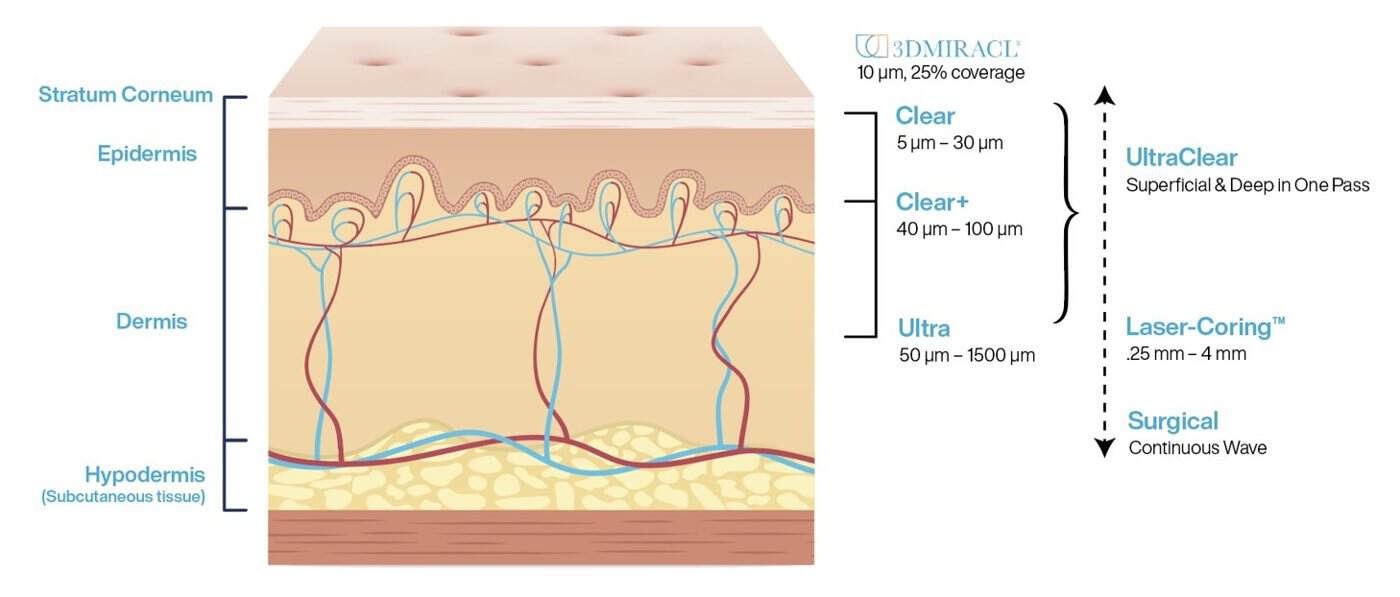
UltraClear is one laser with three distinct treatments, and the concern you walk in with decides which one Dr Mattia uses. A different target means a different depth, and each depth comes with its own recovery. Healing is not something you choose, because the mark in the mirror decides the treatment first.
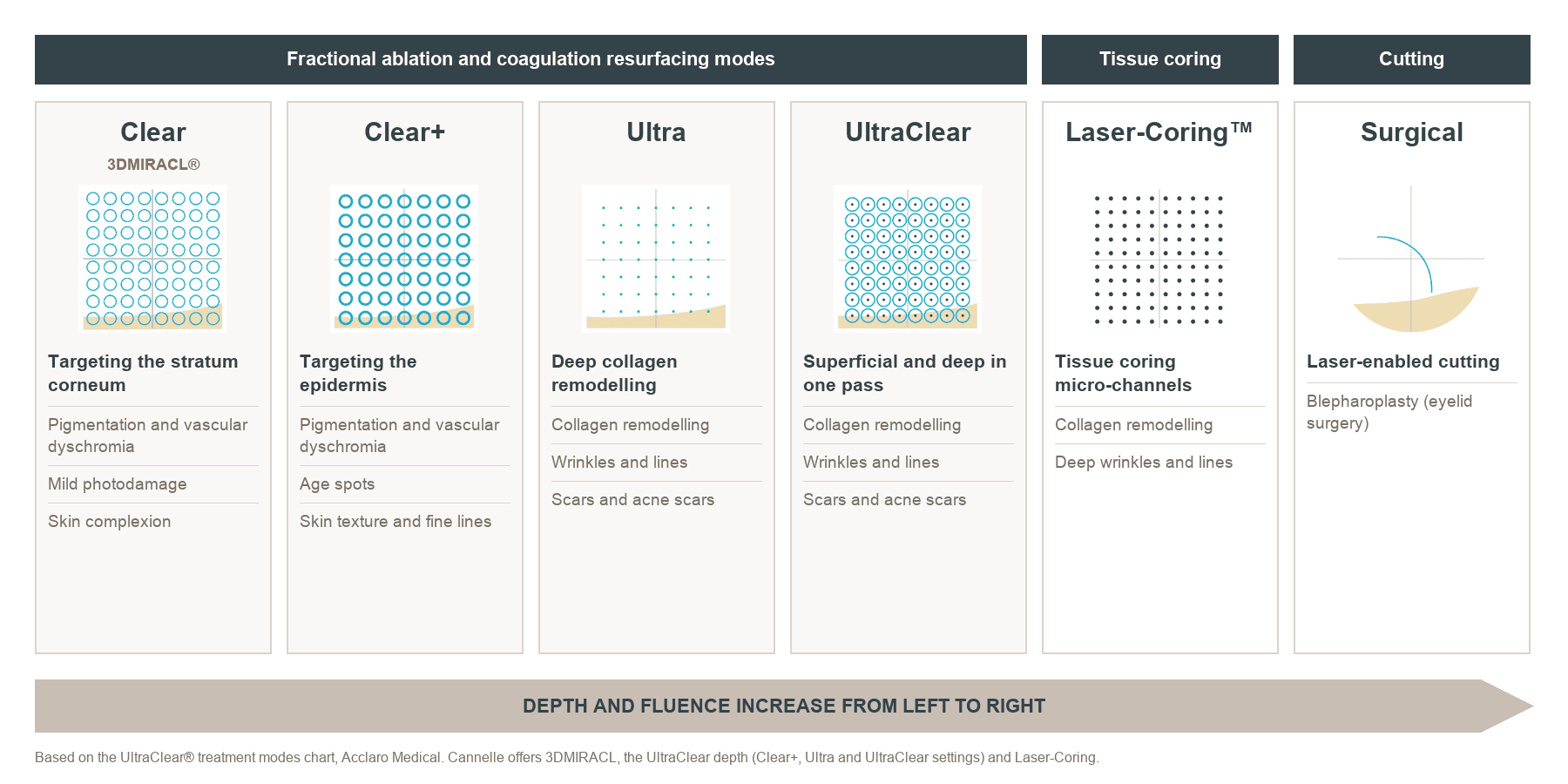
3DMIRACL. The gentlest of the three answers dull tone, early sun damage and the flat look no highlighter fixes. Ten to fifteen minutes covers a face, and no topical numbing is needed at all. A warmth like mild sunburn settles within hours, and there is no formal downtime beyond a faint pink by the evening. A monthly rhythm suits it better than a fixed course.
The UltraClear depth. Fine lines, uneven texture, deeper sun damage, open pores and mild scarring all sit in the mid dermis, and the middle treatment is the one that reaches them. You flush and flake for three to seven days while the new surface arrives. Two or three sessions, three to four months apart, usually finish the change.
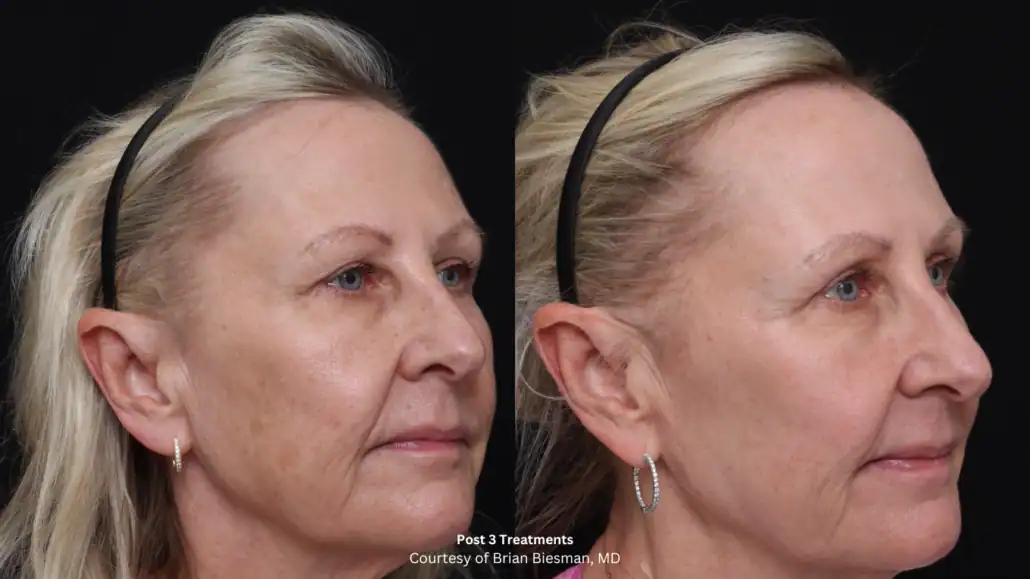
Laser Coring. The deepest of the three answers established acne scarring and texture that has been there for years. It lifts out micro-columns of tissue outright rather than heating them into shrinking. Topical numbing goes on first, and there is pinpoint bleeding on the day, sometimes quite noticeable across scars. Healing takes seven to fourteen days, and one to three sessions is usual.
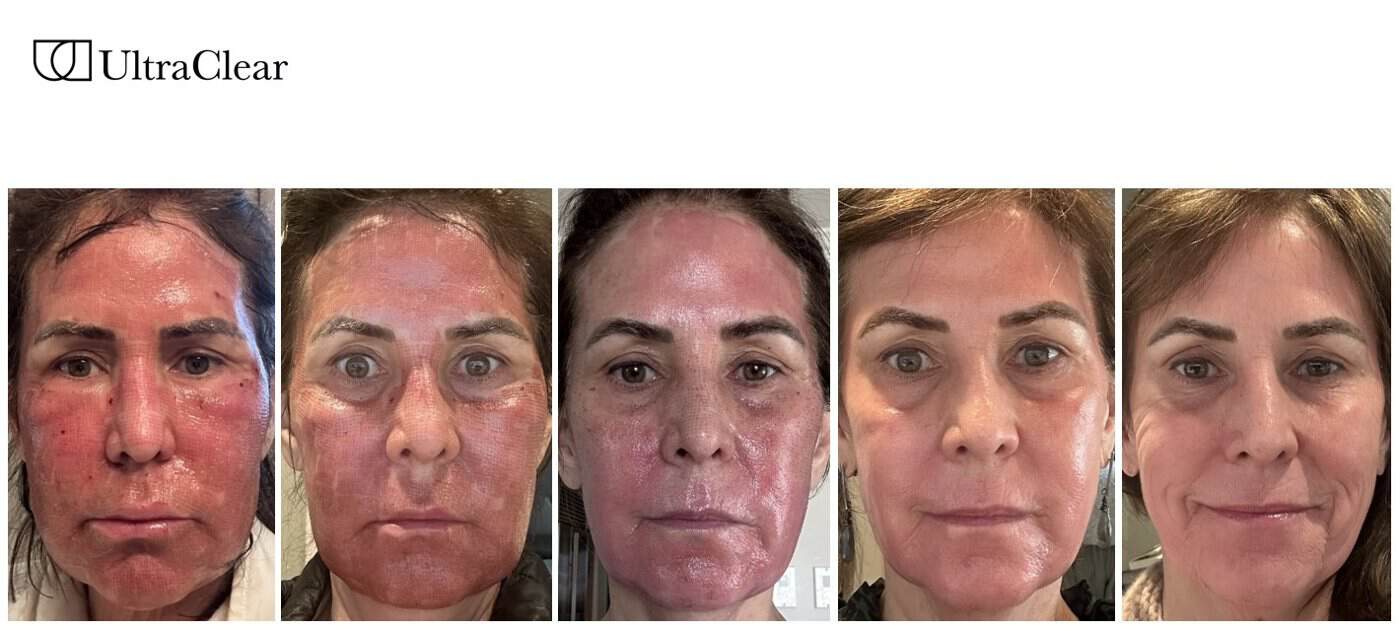
The first honest look at a deeper result comes once healing has finished, and the change then keeps arriving for months while collagen reorganises beneath the new surface. Dr Mattia will ask you to hold your verdict until three months, not three weeks. Tone evens, texture settles, and the light falls differently across the cheek before anyone can name what changed.
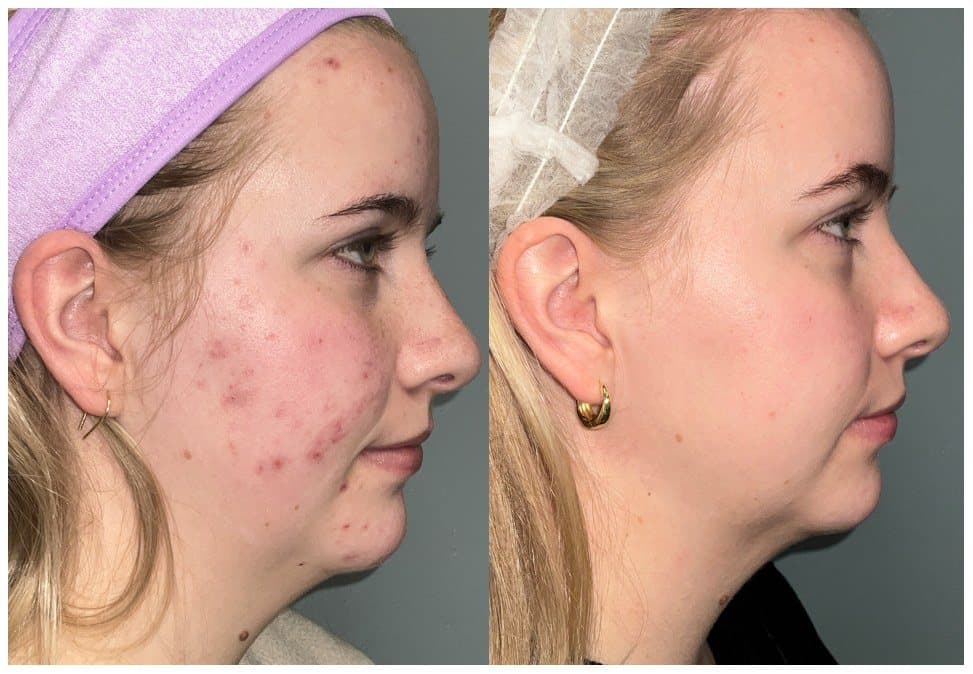
CO2 is not the only laser you may have been offered, and the other two deserve a fair hearing. Fraxel-type lasers work at 1550 and 1927 nanometres and are non-ablative, which means they warm columns of skin without removing anything. The surface stays intact, recovery is a day or two of pinkness, and the improvement is gentler and builds over a course of several sessions. On deeper texture and true scarring that approach tends to plateau, because nothing is actually taken away.
An erbium laser is the closer cousin. Like CO2 it is ablative, so it lifts tissue rather than warming it, and its 2940 nanometre beam is absorbed by the water in skin far more eagerly than a CO2 beam. That leaves much less heat behind, which is why erbium heals faster than CO2, and also why it bleeds more during treatment and tightens less afterwards. Most people are back to normal in around a week.
UltraClear takes the erbium idea and finishes it. At 2910 nanometres the cold fibre sits at the peak of what water absorbs, so about 95 percent of each pulse removes tissue and the small remainder of warmth is enough to settle each channel as it goes. You keep erbium’s short recovery and CO2’s ability to reach deep, and the three depths let Dr Mattia choose how far to take either. The table below sets the four side by side.
The clinical record behind the cold fibre is young and building well. A 2024 acne scar study reported trace to mild redness, swelling and pinpoint bleeding as the whole of what patients went through. Histology from the same year measured the channels at around 980 micrometres deep, with neither dark marks nor scarring reported across that series.
Behind the cold fibre is Acclaro Medical, a US company that makes nothing else. UltraClear is the first and only 2910 nanometre cold ablative fibre laser, it carries FDA clearance for photodamage and for pigmented lesions and vascular redness, it holds NewBeauty’s 2026 Beauty Award in the category Best Laser Treatment for All Skin Tones and a UK Safety in Beauty Diamond Award, and its studies are the ones presented at the American Academy of Dermatology.
Set that beside the CO2 literature and the comparison does the talking. Dark marks and scarring appear far less often in the UltraClear work published so far. That is what you would expect from a laser designed to keep its warmth inside the channel. A young evidence base is not a promise, and Dr Mattia will say so himself.
Recognition has followed. NewBeauty handed UltraClear a 2026 Beauty Award for Best Laser Treatment for All Skin Tones. The title says as much about who can be treated as about what the treatment does. Harper’s Bazaar called cold lasers the hottest new skin treatment in June 2026, which is a pleasing line for a device whose argument is how little heat it leaves behind.
Health Canada approved the 2910 nanometre cold ablative fibre laser in June 2025. Dermatologists reviewed Laser Coring at their American Academy of Dermatology annual meeting in March 2026. A device examined that closely by people who read skin under magnification is worth taking seriously.
A resurfacing laser is only as good as the hand and the judgement behind it. Dr Mattia performs every UltraClear session at Cannelle himself, from the consultation through to the final pass. The settings chosen for your skin are a medical decision rather than a preset on a screen.
He has taken more than 100 of these laser treatments through to their result at our sister clinic in London, Dr Joney De Souza Skin & Laser. That experience is why he can tell which of the three treatments your skin actually wants. It is also why he will say plainly when something else would serve you better.
UltraClear renews the surface and the collagen sitting under it, and it does not put back volume that has already gone. Where a face has lost structure as well as smoothness, he says so and plans for both. Treating a whole face rather than one layer of it is the quiet advantage of a doctor-led clinic.
The laser stays switched off until Dr Mattia has assessed your skin properly. He looks at it in good light, then at your VISIA images, which show the damage sitting below what a mirror gives you. What you would most like to change comes next, and the treatment that answers it follows from there.
If your skin tone is deeper, a patch test comes first. A small, discreet area is treated at the settings he would use, and at least 24 hours pass before your first full session. People told for years that lasers were not for their skin are exactly who that step is for.
He will also run through the questions any careful laser doctor asks. Recent isotretinoin, a tan or sun in the last month, a history of cold sores, pregnancy or breastfeeding, thick scarring in the past, and any medicine that sensitises skin to light. If you had a CO2 treatment before, tell him how it healed, because that history is useful.
You leave with numbers rather than a vague plan. The lightest treatment runs as a monthly rhythm. The UltraClear depth takes two or three sessions three to four months apart, and Laser Coring one to three, four to six months apart. Those are averages, and the consultation gives the real answer for your skin.
Aftercare comes home with you in writing. The lightest treatment asks for daily sunscreen, a gentle moisturiser and nothing active for two days. The deeper treatments send you home with barrier cream and a gentle cleansing routine. Heat, exercise and swimming wait until you have healed, and you get a date for your retinoids and acids to come back.
Cannelle is the only clinic in Oxford where UltraClear is performed by a doctor who has already performed more than a hundred of these treatments, and our Summertown room makes a review at three months a short drive from anywhere in Oxfordshire. Kidlington, Headington and Witney are all an easy run from the clinic door. If a CO2 quote has been sitting in your inbox since the spring, bring it in and talk it through with Dr Mattia.
Read the UltraClear treatment page for the detail on each of the three treatments, and look through the before and after gallery to see those depths at work. Then get in touch, and we will find you a consultation time.
The doctor who performs every UltraClear session at Cannelle, filmed treating with the same laser at our sister clinic in London, Dr Joney De Souza Skin & Laser. Watch how the handpiece moves, how calm the skin stays, and how little fuss the whole thing involves.
Every resurfacing laser makes the same trade between depth and heat. The table shows where each one lands, and why the cold fibre changes the terms of that trade.
| Laser | How it works and where the heat goes | Typical recovery |
|---|---|---|
CO2, 10,600 nm | Ablative. Vaporises columns of skin and warms the skin around every channel. | Seven to fourteen days, redness for weeks |
Erbium YAG, 2,940 nm | Ablative. Water absorbs the beam readily, so little heat is left. Heals faster, bleeds more, tightens less. | Around a week |
Fraxel-type, 1,550 and 1,927 nm | Non-ablative. Warms columns without removing the surface. All heat, spread over several sessions. | A day or two, each session |
UltraClear, 2,910 nm cold fibre | Ablative. About 95 percent of each pulse removes tissue; about 5 percent stays as warmth inside the channel. | None (3DMIRACL), three to seven days (depth), seven to fourteen (coring) |
If the recovery was the only thing keeping you from resurfacing, book a consultation with Dr Mattia at our Summertown clinic. Bring any quote you have been given and he will show you what the cold fibre does. Message us on WhatsApp, or call 01865 511960 and we will find you a time.
These are the questions we hear most from people who have already been quoted for a CO2 laser. Anything not covered here is worth bringing to your consultation, where Dr Mattia will answer it properly.
Both are ablative fractional lasers, so both resurface by removing microscopic columns of damaged skin and letting your own healing rebuild what sits underneath. The difference is where the energy goes. UltraClear works at 2910 nanometres through a cold fibre, with about 95 percent of each pulse removing tissue and only about 5 percent left as warmth, which is why healing is counted in days at the lighter depths.
It reaches the concerns CO2 was famous for, at the depth of whichever treatment Dr Mattia selects. Laser Coring lifts out micro-columns of tissue, and published histology measured those channels at around 980 micrometres, which is deep dermal work. The middle treatment sits in the mid dermis for fine lines, texture and sun damage, while the lightest stays at the surface for tone and brightness.
Conventional CO2 resurfacing is usually described as seven to fourteen days of swelling and deep redness, with pinkness lingering well beyond that. UltraClear splits into three treatments, and the one your skin needs sets the healing that comes with it. The lightest leaves no formal downtime and a faint pink at most, the middle treatment brings three to seven days of flushing and flaking, and Laser Coring takes seven to fourteen days.
Heat and melanin together are what set pigment off. A conventional CO2 laser spreads warmth into the skin around every channel it makes, and pigment-rich skin answers that warmth by making more pigment. Published series recorded temporary dark marks in a third to a half of Asian-skin patients after fractional CO2, which is why so many people were steered away from resurfacing altogether.
It is designed for all six Fitzpatrick skin types, and the reason is the same ratio that shortens healing, since so little warmth ever reaches the skin beside each channel. Deeper tones start with a patch test on a small, discreet area, and your first full session follows at least 24 hours later. NewBeauty gave the laser a 2026 award for Best Laser Treatment for All Skin Tones.
Any treatment that removes tissue deserves a straight answer, and the honest one is comparative rather than absolute. Scarring with lasers is driven largely by heat spreading beyond its target, and a cold fibre is built to hold its warmth inside the channel it makes. Published histology of Laser Coring reported neither scarring nor dark marks in that series, and Dr Mattia sets every parameter himself.
Yes, and it is worth knowing before you book. Coring lifts out micro-columns of tissue rather than heating them, so pinpoint bleeding appears on the day and can be quite noticeable across scars. It settles as the skin seals over the following day or two, and seven to fourteen days of healing follow. That removal is exactly why coring reaches scars heat alone never shifted.
The lightest of the three goes ahead without numbing and feels like warm sunburn for a few hours. Topical numbing goes on before the UltraClear depth and before Laser Coring, so what you feel is heat and prickling rather than sharp pain. He runs every session himself and changes the settings as he works, so nothing is pushed further than your skin wants.
Previous resurfacing is useful history rather than a barrier, and Dr Mattia will want to know what was done, when it was done and how your skin healed afterwards. He reads your skin and your VISIA images at the consultation, then decides which of the three treatments suits what is left to improve. Plenty of people arrive with one good CO2 result behind them.
Dr Mattia Parducci (GMC 7635663) performs every UltraClear session at Cannelle from start to finish. Over 100 of these laser treatments are already on his record at Dr Joney De Souza Skin and Laser, our sister clinic in London. The settings are his medical decision rather than a preset, and the UltraClear treatment page sets out all three treatments.
Our clinic is located in Summertown, Oxford, just north of the city centre in one of Oxford’s most sought-after neighbourhoods. Discreet and easy to reach, we offer a premium setting for bespoke skin, aesthetic and wellness care.
We welcome patients from across Oxford city and Oxfordshire, including Summertown, Headington, Kidlington, Abingdon, Bicester, Witney and the surrounding towns and villages. Whether you’re coming for routine skin-health treatments or specialist aesthetic consultations, our location is well connected and simple to access.
Our clinic, Cannelle Skin Clinic, is just minutes from Oxford city centre and easily reached by car, bus or rail. Oxford’s mainline stations Oxford Station and Oxford Parkway are a short taxi or bus ride away, and regular services link to London, Reading, Didcot, Banbury and beyond.
By car, we’re conveniently accessed via key local routes with nearby parking options; by public transport, frequent bus routes along Banbury Road drop you within a short stroll of the clinic.
Whether you’re travelling from within Oxfordshire, further afield in the UK or internationally, our clinic offers a calm, personalised and professional environment for your visit.