You wanted resurfaced skin without a fortnight indoors. UltraClear, the cold fibre laser now at Cannelle in Oxford, keeps its heat inside the channel so your skin heals in days, performed by Dr Mattia.
You have looked at laser resurfacing more than once. Each time the same detail sent you away again. The results were lovely, and the price was a fortnight indoors with a face too red for the office or the school run. UltraClear at Cannelle Skin Clinic in Oxford takes that fortnight out of the plan.
The elegance of a cold fibre laser is in where the energy goes. Around 95 percent of each pulse goes into lifting away damaged tissue. Only about 5 percent lingers as warmth, and that warmth stays inside its own microscopic channel rather than spreading into the skin beside it. The skin between the channels stays calm and heals from the first evening.
The experience arrived from London first. At our sister clinic Dr Joney De Souza Skin & Laser, Dr Mattia Parducci (GMC 7635663) has performed more than 100 of these laser treatments. Every UltraClear session in Oxford is now his from the first pass to the last, and his profile page carries the detail.
For three decades the CO2 laser was how a face was properly resurfaced, and it earned its reputation. It could take deep lines, years of sun damage and pitted scarring down in a single determined session. A great many smooth, even complexions of the last twenty years owe it a quiet debt.
The cost was heat. A conventional CO2 laser pours warmth into the skin around each channel as it works. That warmth is what stretched recovery to a fortnight of swelling and deep redness, with pinkness that published series recorded for up to three months. The face underneath was healing beautifully, but for two weeks nobody could see it.
That same heat is why CO2 was so often ruled out for deeper skin tones. Warmth and melanin together make dark marks. Published series reported temporary dark marks in roughly a third to a half of Asian-skin patients after fractional CO2. If you were offered the hot version and kept your holiday instead, that was fair.
UltraClear works at 2910 nanometres through a cold fibre, and it is both ablative and fractional. Ablative means it truly lifts away the damaged surface rather than only warming it. Fractional means it does so through thousands of microscopic channels, leaving healthy skin between them to knit the new surface together.
The clever part is the ratio. With about 95 percent of the energy removing tissue and about 5 percent left as heat, the warmth has nowhere to travel. It sits within the channel and fades, and the skin around it is spared. That one change shortens healing and widens the range of skin tones that can safely be treated.
The wider world has noticed. Harper’s Bazaar called cold lasers the hottest new skin treatment in June 2026. It is a pleasing way to describe a laser whose whole point is how little heat it leaves behind. Thirty-three clinics now run UltraClear across the UK, around twenty of them in London, and Oxford has only just joined the map.
What that means for you is a resurfacing laser whose recovery is counted in days rather than a fortnight. Its warmth is gentle enough to be considered for skin tones that CO2 excluded. It is a genuine CO2 laser alternative, and it has arrived in a doctor-led clinic where every session is performed by Dr Mattia.
The laser comes from Acclaro Medical, a US company built around this one idea, and UltraClear is the first and only 2910 nanometre cold fibre laser on the market. It holds FDA clearance for photodamage and, since 2024, for pigmented lesions and vascular redness, NewBeauty’s 2026 award in the category Best Laser Treatment for All Skin Tones, and a Safety in Beauty Diamond Award in the UK. Its clinical work is presented each year at the American Academy of Dermatology, which is where the dermatologists who set the standards go to compare notes.
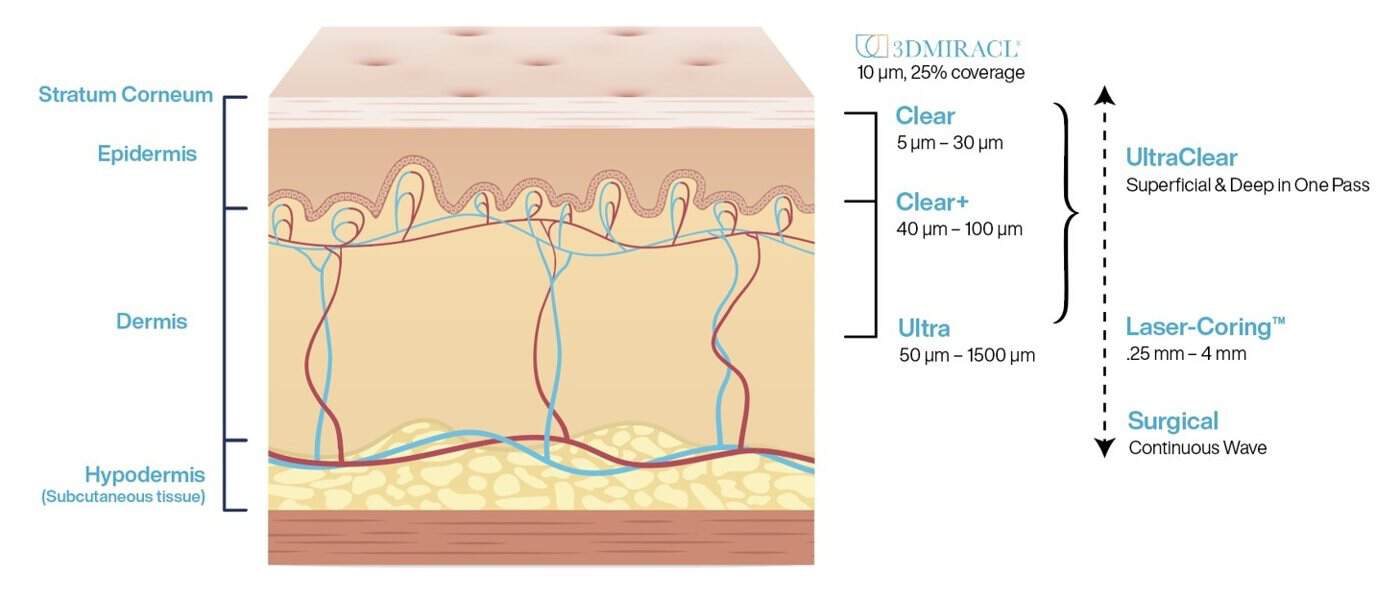
UltraClear is one laser with three distinct treatments, and the concern you bring decides which of them Dr Mattia uses. Different targets call for different depths, and each depth carries its own healing. The plan begins with what you see in the mirror rather than with a menu.
3DMIRACL. This is the lightest pass, for dull tone, early sun damage and the brightness a good facial gives you for a fortnight and then quietly takes back. It takes ten to fifteen minutes with no topical numbing. You feel a sunburn-like warmth that settles within hours, and at most a faint pink by the evening.
The manufacturer puts any redness after 3DMIRACL at two to three days, against seven to fourteen for CO2. There is no formal downtime. Most people book it on a monthly rhythm rather than as a course, and the glow builds further with each visit. Your skin looks fresher month by month rather than for a fortnight at a time.
UltraClear depth. The middle treatment reaches the mid dermis, where fine lines, uneven texture, deeper sun damage, open pores and mild scarring live. Expect three to seven days of flushing and flaking while the new surface comes through. Typically it takes two or three sessions, three to four months apart, for the full change to show.
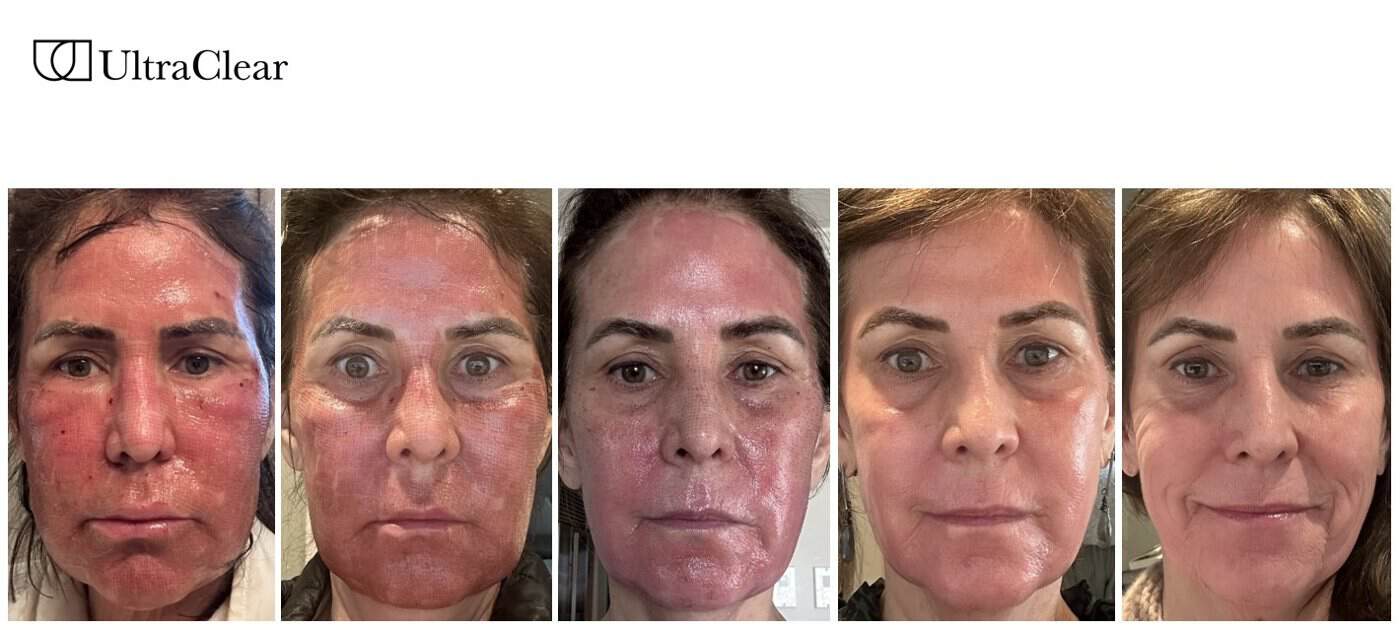
Laser Coring. The deepest treatment is for established acne scarring and long-standing texture. It was presented at the American Academy of Dermatology annual meeting in March 2026. Under topical numbing it removes micro-columns of tissue outright rather than heating them, which is what lets it reach scars that heat alone never quite shifted.
Because tissue is removed, there is pinpoint bleeding on the day, sometimes noticeable on scars, and then seven to fourteen days of healing. Often one to three sessions, four to six months apart, is the plan. Our page on acne scarring explains what Dr Mattia looks for when he assesses a scar.
The light settings do one more thing worth knowing about. Their US clearance extends to vascular dyschromia, the diffuse redness and fine visible vessels that sit alongside sun damage on many fair complexions, so a face that reads as flushed and freckled is treated in the same pass. Our page on facial redness explains where a laser fits and where it does not.
After 3DMIRACL the brightness arrives within days. It is the kind of clarity that makes the light fall differently across the cheek before anyone can say what has changed. After the deeper treatments there is nothing to judge until the healing is finished. The change then keeps arriving for months, because the collagen beneath the new surface is still reorganising.
Texture, tone and firmness keep improving for three to six months after a deeper session. Dr Mattia asks you to judge the result at three months rather than at three weeks. Fine lines that concealer had started to gather in rather than cover grow softer, pores tighten, and the skin looks rested from across a room.
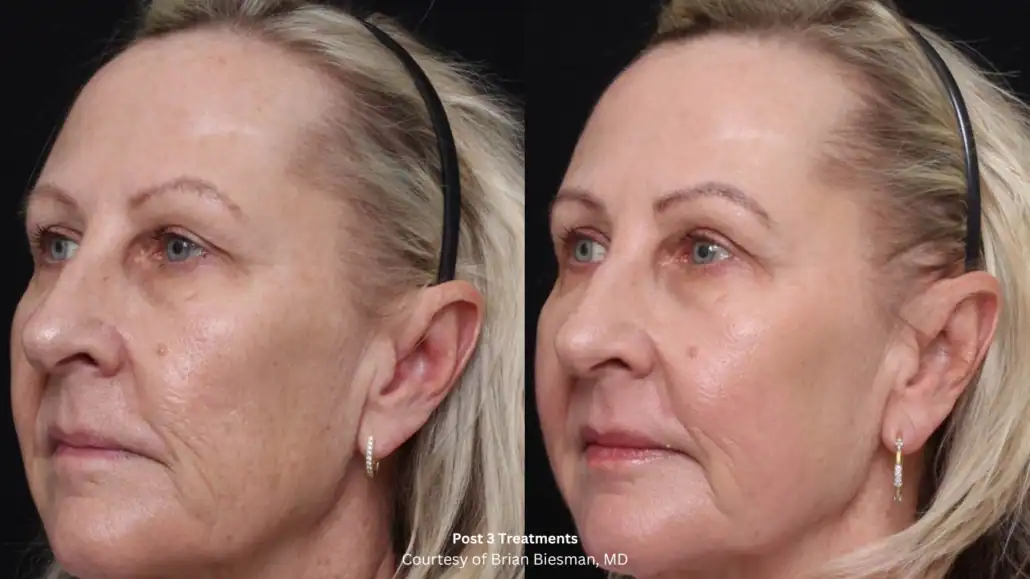
Aftercare is written down for you before you leave. After 3DMIRACL it is sunscreen every day, a gentle moisturiser and nothing active for 48 hours. After the deeper treatments you take home a routine of barrier cream and gentle cleansing. There is no heat, exercise or swimming until healed, and a set date to bring your retinoids and acids back.
UltraClear works on the surface and the collagen beneath it. Where a face has also lost volume, Dr Mattia says so at the consultation and plans for both, usually with a biostimulator alongside. It is one of the quiet advantages of a doctor who treats the whole face rather than a single layer of it.
Nothing is booked until you have sat down with Dr Mattia. He reads the skin itself first, then the VISIA images, which bring up the sun damage and texture sitting below what a bathroom mirror reveals. From there you talk through what you would most like to change and which of the three treatments answers it.
If you have a deeper skin tone, Dr Mattia patch-tests a small, discreet area first. He then waits at least 24 hours before the first full session, so your skin is already understood before it is treated. If another treatment would serve your skin better, he says so plainly and explains his reasoning.
He will also ask a handful of questions that decide whether your skin is ready. Recent isotretinoin, a tan or a sunny holiday in the last month, a history of cold sores, pregnancy or breastfeeding, and any tendency to scar thickly all change the plan or its timing. Answer them honestly and the treatment is safer for it.
On average 3DMIRACL is a monthly rhythm, the UltraClear depth is two or three sessions, and Laser Coring is one to three. Your own figures are settled once he has looked properly at your skin. You leave knowing what is being treated, how long healing takes, and the date on which you can expect to look at the result properly.
Cannelle is the only clinic in Oxford where UltraClear is in the hands of a doctor who has already performed more than a hundred of these treatments, and it sits in our Summertown treatment room, welcoming patients from across Oxfordshire. People reach it from Kidlington, Wolvercote and Headington without booking a train into London for the day. If resurfacing has sat on your list for years, come and talk to Dr Mattia. Have a look at the UltraClear treatment page and its before and after gallery, then get in touch to arrange your consultation.
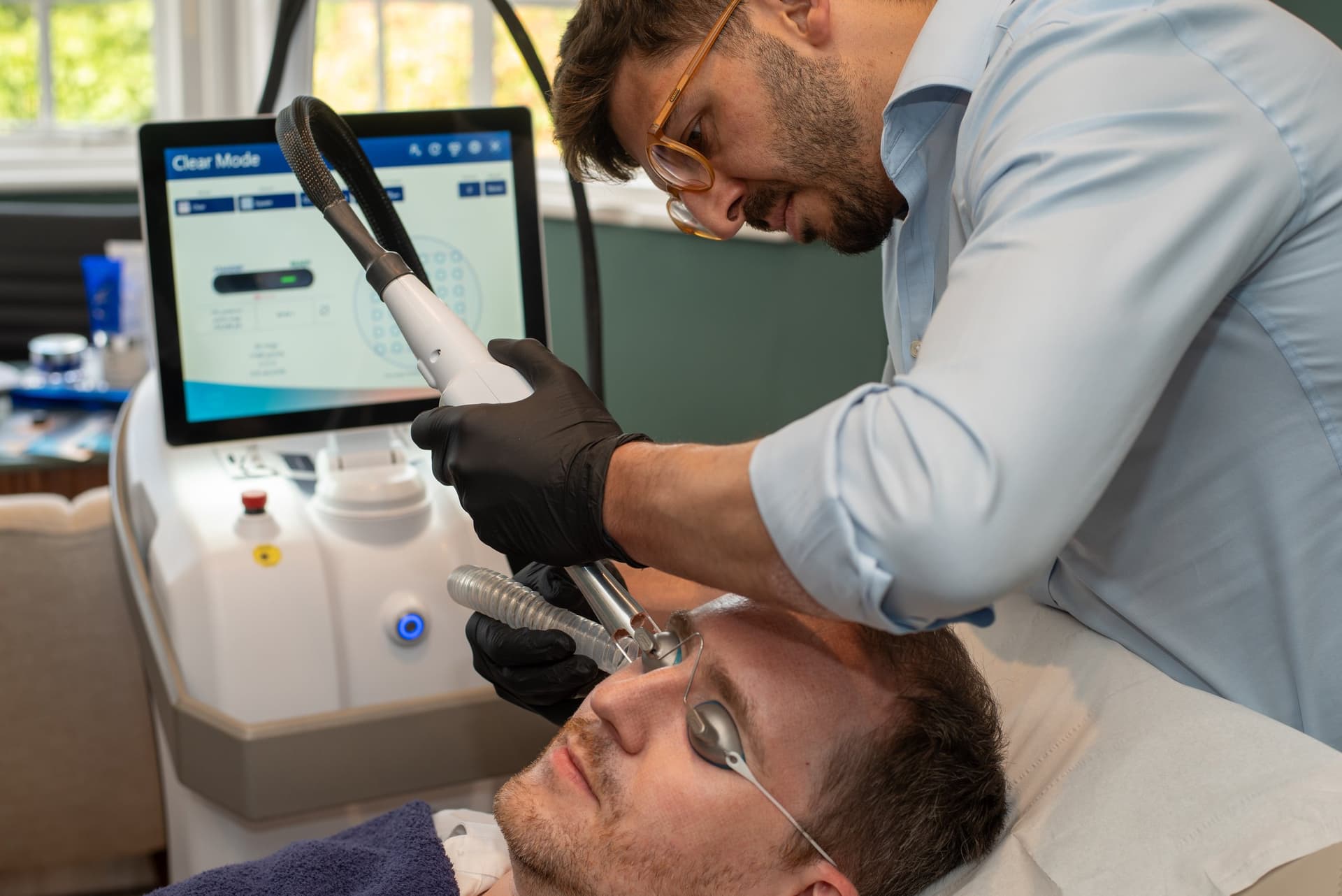
The doctor who performs every UltraClear session at Cannelle, filmed treating with the same laser at our sister clinic in London, Dr Joney De Souza Skin & Laser. Watch how the handpiece moves, how calm the skin stays, and how little fuss the whole thing involves.
If the recovery was the only thing standing between you and smoother, brighter skin, come and see what a cold fibre laser changes. Book a consultation with Dr Mattia at our Summertown clinic, message us on WhatsApp or call 01865 537885, whichever of the three suits you best.
These are the questions we hear most from people weighing UltraClear against the CO2 laser they were once offered. If yours is not here, Dr Mattia will answer it properly at your consultation.
UltraClear is a 2910 nm cold fibre laser that resurfaces skin through thousands of microscopic channels, exactly as a CO2 laser does, but with about 95 percent of its energy removing tissue and only about 5 percent left as heat. That is why healing runs to days rather than a fortnight, and why Dr Mattia can consider it for deeper skin tones that CO2 excluded.
It treats the same concerns, fine lines, sun damage, open pores, uneven texture and acne scarring, and it reaches the same depths through three different treatments. The difference is where the heat goes, not how much surface is renewed. Collagen keeps rebuilding beneath the new skin for three to six months, and Dr Mattia asks you to judge the result at three months.
The concern decides the treatment, and each treatment carries its own healing. 3DMIRACL leaves a sunburn-like warmth that settles within hours and at most a faint pink, with no formal downtime. The UltraClear depth brings three to seven days of flushing and flaking, and Laser Coring seven to fourteen days. Conventional CO2 resurfacing is usually described as a fortnight of redness and swelling.
3DMIRACL needs no topical numbing at all and feels like a warm sunburn that fades within hours. For the deeper treatments Dr Mattia applies topical numbing first, and you feel warmth and a prickling sensation rather than sharp pain. He performs every session himself in Oxford and adjusts the settings to your skin as he goes, so you are never left to tolerate more than you need to.
Every UltraClear session at Cannelle is performed by Dr Mattia Parducci (GMC 7635663), who leads the clinic as our Lead Aesthetic Doctor. More than 100 of these laser treatments already sit behind him, done at our sister clinic in London, Dr Joney De Souza Skin & Laser. Your plan is set at a consultation with VISIA skin imaging, before anything is switched on.
Yes, it is designed for all six Fitzpatrick skin types, because so little heat spreads into the skin around each channel. Dr Mattia patch-tests deeper tones on a small, discreet area first and waits at least 24 hours before the first full session. That care is what lets people who were told lasers were not for them finally have their skin resurfaced.
The concern decides. Dull tone, early sun damage and general brightness call for 3DMIRACL, the lightest pass. Fine lines, texture, open pores and mild scarring sit in the mid dermis and call for the UltraClear depth. Established acne scarring and long-standing texture call for Laser Coring, the deepest treatment. Dr Mattia matches the treatment to what he sees at your consultation.
3DMIRACL is a monthly rhythm rather than a course, with the glow building visit by visit. The UltraClear depth is typically two or three sessions, three to four months apart. Laser Coring is often one to three sessions, four to six months apart. Those are averages, and your own course is set once Dr Mattia has seen what he is treating.
Yes, and it is worth knowing in advance. Laser Coring removes micro-columns of tissue outright rather than heating them, so there is pinpoint bleeding on the day, sometimes noticeable across scars, which settles as the skin seals over the following day or two. It is the reason this treatment reaches established acne scarring so well, and Dr Mattia talks you through the whole seven to fourteen day healing plan.
UltraClear has only recently reached Oxford, and Cannelle Skin Clinic in Summertown is the only clinic in the city where it is performed by a doctor with more than a hundred treatments behind him. Thirty-three clinics run it across the UK, around twenty of them in London, and Dr Mattia has been performing it at our sister clinic there for some time. Patients come to us from across the city and beyond, and the UltraClear treatment page has the full detail.
Our clinic is located in Summertown, Oxford, just north of the city centre in one of Oxford’s most sought-after neighbourhoods. Discreet and easy to reach, we offer a premium setting for bespoke skin, aesthetic and wellness care.
We welcome patients from across Oxford city and Oxfordshire, including Summertown, Headington, Kidlington, Abingdon, Bicester, Witney and the surrounding towns and villages. Whether you’re coming for routine skin-health treatments or specialist aesthetic consultations, our location is well connected and simple to access.
Our clinic, Cannelle Skin Clinic, is just minutes from Oxford city centre and easily reached by car, bus or rail. Oxford’s mainline stations Oxford Station and Oxford Parkway are a short taxi or bus ride away, and regular services link to London, Reading, Didcot, Banbury and beyond.
By car, we’re conveniently accessed via key local routes with nearby parking options; by public transport, frequent bus routes along Banbury Road drop you within a short stroll of the clinic.
Whether you’re travelling from within Oxfordshire, further afield in the UK or internationally, our clinic offers a calm, personalised and professional environment for your visit.